A broken heart takes time to heal. What’s worse is that you can become physically ill due to your broken heart.
Takotsubo Syndrome (TTS), also known as the Broken-Heart Syndrome and Takotsubo Cardiomyopathy, is due to severe left ventricular dysfunction. The acute onset of this cardiac diagnosis is triggered by extreme emotional, psychological, or physical stressors. Interestingly, studies show that men are more likely to experience TTS due to physical stressors, while women experience TTS related to emotional stressors. The symptoms can often mimic myocardial infarction due to chest pain/chest tightness, dyspnea (labored breathing), syncope (loss of consciousness), generalized weakness, and fever. These symptoms will often resolve within hours to a few days when given the proper medical attention. On the other hand, some patients are completely asymptomatic and will be indicative of TTS through ST elevation on an EKG.
So, if you’re listening to sad music, downing a pint of ice-cream, and experience some sharp chest pain after hearing some tragic news, maybe you’re not overreacting. Maybe your heart does need a band-aid.
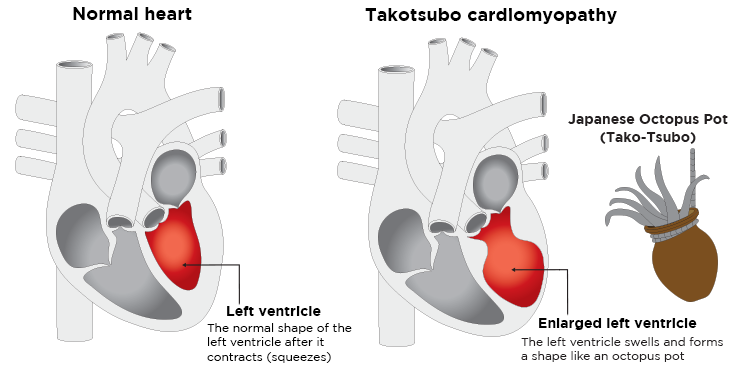
Takotsubo literally means “octopus-pot” in Japanese, which describes the visual representation of the left ventricular apical ballooning of the heart. Simply put, it is the enlargement of the left ventricle (see figure 1).
https://www.heartfoundation.org.nz/your-heart/heart-conditions/takotsubo-cardiomyopathy
TTS can be detected through EKG and blood tests including troponin, creatine kinase-MB, and brain natriuretic peptide (BNP). The detection of BNP or N-terminal pro-B-type natriuretic peptide indicates ventricular stretching. EKGs are monitored to rule out any acute myocardial infarction or CAD given that TTS patients do not have reciprocal ST elevation changes or Q wave abnormalities. While it is common for TTS patients to have an EKG with ST-elevation, some patients also have diffuse T-wave inversions of the anterior and lateral leads. Figure two presents a patient with ST-elevation.

http://hqmeded-ecg.blogspot.com/2010/12/takostubo-stress-cardiomyopathy-with.html
Additionally, patients were also found to have high levels of catecholamines. Catecholamines are hormones released by the adrenal glands due to high levels of emotional and physical stress. When the body experiences stress, the autonomic nervous system is activated through the release of norepinephrine via cardiac sympathetic nerve terminals and epinephrine via adrenal medulla. A patient with TTS will release norepinephrine and epinephrine in response to the stressors. The release of norepinephrine results in tachycardia due to the increased contraction. As seen in figure three, patients with TTS produce significantly higher levels of epinephrine and norepinephrine compared to patients with a myocardial infarction.

https://www.ahajournals.org/doi/full/10.1161/CIRCULATIONAHA.116.027121
Providers will often treat TTS with anticoagulants such as aspirin or heparin. Providers will also suggest following up with a cardiologist for further evaluation if symptoms persist.
Takotsubo Syndrome is a relatively new condition and we have so much more to learn. It is interesting to see the physiology of the neurological and cardiac systems working together to bring the body back to baseline.
A broken heart can be more serious than you imagined.
References
Merchant, Emily E, et al. “Takotsubo Cardiomyopathy: a Case Series and Review of the Literature.” The Western Journal of Emergency Medicine, Department of Emergency Medicine, University of California, Irvine School of Medicine, May 2008, http://www.ncbi.nlm.nih.gov/pmc/articles/PMC2672240/.
Pelliccia, Francesco, et al. “Pathophysiology of Takotsubo Syndrome.” Circulation, 13 June 2017, http://www.ahajournals.org/doi/full/10.1161/CIRCULATIONAHA.116.027121.
 Med Thoughts
Wow. A blog post that I couldn’t stop reading. I never thought of the real physiological affects that a broken heart can have on someone. This is amazing and so informative!!
LikeLiked by 1 person
Hi Barbara, thank you so much for your kind words! Your interest inspires me to continue to keep learning and sharing along the way!
LikeLike
It’s amazing how an emotion, which is technically a psychological phenomenon, can invoke such a real and destructive physiological response. Such an interesting and informative read, looking forward to many more!
LikeLiked by 1 person
Thank you so much! It makes me so happy that I can share my learning adventures with you all!! So excited to share more
LikeLike